

During the month of May, which Mental Health Awareness Month, people and organizations are encouraged to speak more openly about mental health. NeighborWorks® America had the chance to sit down with Kate de la Garza, executive director of Ithaca Neighborhood Housing Services, for a wide-ranging conversation with a mental health focus. de la Garza has been at the helm of the organization, currently celebrating its 50th anniversary, since January 2024.
NeighborWorks America: Tell us how you started your tenure at INHS.
Kate de la Garza: The Affordable housing industry is sort of bifurcated between property management and development. I was told early on in my career by a boss not to talk to property management colleagues – “They will tell you you’re doing everything wrong so ignore them.” It became my life’s mission to do the exact opposite of that. I wanted to know if the buildings I was building were working for people, because they’re why we do what we do.
At my first staff meeting here, I said: I'm going to be visiting every property. I'm going to talk to every person in this organization. “What do I need to know? What's not happening here that you want to happen? What do you think we should change?”
The message it sent out was: “You have a voice here. I see what you’re doing for us and I care” 
NeighborWorks America: How do you care for your community, including your staff?
de la Garza: Our orientation has been putting people at the center of everything we do. I tell my staff, especially my frontline staff, that we can't take care of anyone else if we're not taking care of each other. We cannot be there for anybody and fulfill our mission if we're not doing it first for our team. That involves having hard conversations. That involves having the courage to speak up if you see something that looks or feels wrong. This is the premise, for me, of psychological safety in the workplace and trauma-informed care.
We have to talk about really hard things, including that our industry is built on the backs of frontline folks who make between $15 and $20 an hour. It starts with how we treat each other, but I can't expect people to move the needle if I'm not paying them a living wage. Can I solve it all in a year or two? No. But we’re going to talk about it and plan to improve it, okay?
NeighborWorks America: I’ve heard you describe your maintenance staff as frontline workers. Could you talk a little about that?
de la Garza: One of our biggest communities is called Founders Way. It's 75 units in downtown Ithaca at a crossroads of three different neighborhoods. Historically it has been kind of a transitional area of town, As you move from one neighborhood to another, with a lot of activity surrounding it at all times. We delivered 75 units during COVID at this building with 13 units for permanent supportive housing through the NYS ESSHI program. It was one of the first buildings that I visited because there was a lot going on in terms of police activity, people slipping into the building to find places to sleep and use at night. I remember walking down one wing of the building with my head of maintenance who had said that day, “Hey, so I think I'm going to order a bulletproof vest. They have them on Amazon.” I was two weeks in and I was like, “Wait, what? Are you serious?”
So I go with him to the building and we’re walking down a hallway and he says: “In this unit, we’re having a lot of squatters.” And a person shimmies out of that apartment and drops a hypodermic needle on the floor. … It's a family building and residents, including kids, are picking up needles. It is later revealed that a resident was in crisis and allowing many people from The Jungle – an unhoused encampment in Ithaca – to share her apartment with her.
The maintenance crew are the first responders in our work. They see people first when they're struggling with drug addiction or a mental health crisis. Seeing that was really my first chance to see things more clearly. I know what's going on here and I want to make it better. I want to make it better for staff. But at the heart of that is: It has to be better for our residents. We cannot have communities that people don't feel safe living in. And we have to support residents in crisis.
NeighborWorks America: Have you been able to change that?
de la Garza: As a leader you have to look for a solution that does more than put on a Band-aid. So what's the underlying solution here? People need a place to sleep at night. There's a fentanyl epidemic in our community. How are we going to deal with this?
We agreed to hire 24-hour unarmed security to police the doorways and make sure people weren’t slipping in behind people. We worked with the Human Services Coalition to dispatch nighttime outreach workers to meet with the people in the building and help them get to where they need to go – to get services.
Our goal was to have them meet with people who can actually help them. To fix the doors that have been broken where people have been sneaking in. We also created a position in house to provide wraparound services and work with residents who are a crisis and try to reduce eviction rates.
NeighborWorks America: How do you model mental health awareness for employees?
de la Garza: I had a property manager tell me they were going out of town for the next week and I said, “please don't check your email. Please, please, please check out for a week. Do not think about work.” We each need that time.
I'm getting a handle on that more, because this work is a lot. I kind of knew my job would be 24 hours a day. How I model that is tough. Maybe it's just not looking at my phone when I'm with my kids, you know? Baby steps.
I’m married to a licensed social worker therapist, so part of it is seeing the hard things, acknowledging the hard things so that people feel like there’s permission to talk about them. Sometimes I purposely share my own struggles, so people know it’s okay to be struggling with this and it’s okay to ask for help.
Mental health, as a leader, is one of my top priorities. Alongside keeping my organization healthy and sustainable.
NeighborWorks America: What are some of your lessons learned?
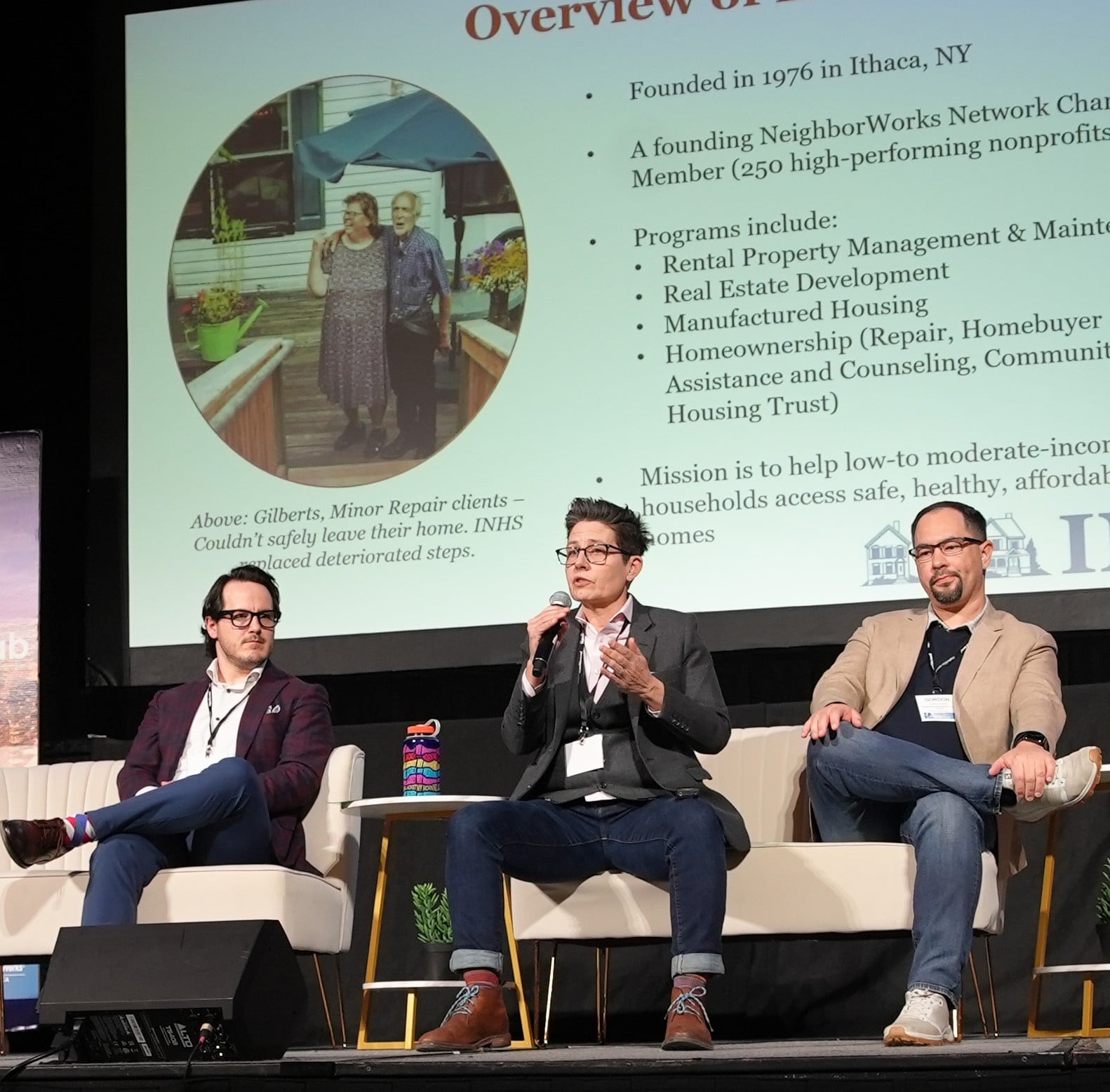
de la Garza: Building a 75-unit property during Covid with permanent housing was a steep learning curve for us. But you have to be able to learn and change the things that aren’t going well or working. Staff have to be able to safely say: “I’ve got a different idea. Can we try this?”
NeighborWorks America: I hear you’ve brought trauma-informed training programs in for your staff?
de la Garza: Yes. And three months in I brought in a facilitator to do a training on psychological safety in the workplace and what this looks like.
Another change we made: We did a lot of wellness checks during COVID, but now we call the fire department and they enter first when someone is not responsive.
I’m trying to figure out how to do a supplemental Employee Assistance Program where a therapist comes to an incident on site. Staff are always not going to want to fall apart in front of their leaders, but I want to make sure they feel okay to do this when needed.
NeighborWorks: What’s next for you?
de la Garza: We’re working on scaling our resident services platform. Values-based leadership and the act of really seeing what people are going through – seeing the work that actually happens, day-to-day, is important.
Harnessing people-based energy to do good and to take care of each other, to advance, to grow our resident services platform to better care for our residents when they're in crisis especially, and to get people caught up on rent and have fewer evictions.
Valuing people is at the heart of what we do, and it allows us to see clearly what we need to change so that we can move better and move faster and be more financially sustainable – not to enrich ourselves individually, but to be a more long-term, innovative organization.